Heritage Building Information Modelling (HBIM) represents one of the most transformative methodologies currently shaping the future of Cultural Heritage (CH) documentation. While traditional Building Information Modelling (BIM) has long been used to support the planning, design, and construction of contemporary buildings, HBIM adapts and extends this approach to the unique and complex world of cultural and/or historical buildings as well as the assets and objects within. Rather than simply serving as a technical tool, HBIM provides a deeply integrated environment that captures the physical, material, historical, and cultural dimensions of heritage assets in a structured, interoperable and sustainable digital form.
HBIM allows professionals to create detailed digital replicas of historic buildings, capturing architectural features, construction methods, materials, modifications, conservation efforts, and stories. These models support research, conservation, monitoring, storytelling, education, and policy.
For HERITALISE, HBIM holds special value. It aligns directly with the project’s ambition to revolutionise how digital heritage is captured, enriched and shared across Europe through advanced technologies and the development of Digital/Memory Twins. As HERITALISE works to create interoperable, high-quality digital assets that integrate visible, non-visible and contextual information, HBIM provides a powerful structural backbone capable of organising, relating and preserving these diverse data layers.
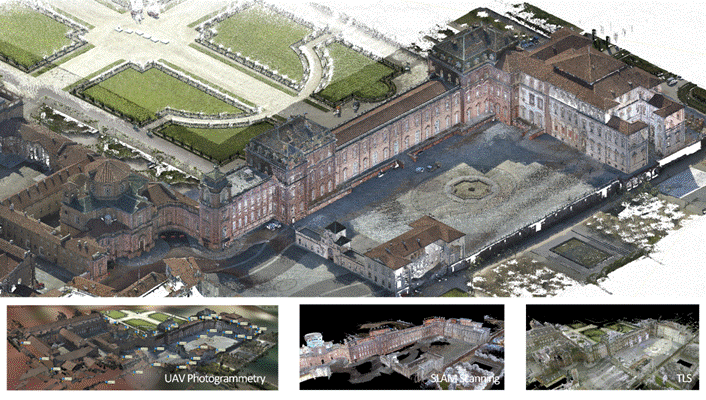
Figure 1 Reggia di Venaria Reale — fused point-cloud overview of the Galleria Grande and the Church of Sant’Uberto (HERITALISE case-study assets).
In the context of the European Collaborative Cloud for Cultural Heritage (ECCCH), HBIM plays a central role by enabling the integration, connection, and reuse of digital heritage information across borders and institutions. It offers a common language, structure and standards that support the long-term sustainability of heritage data and ensure that digital representations remain accessible, comparable, and trustworthy for decades to come.
HBIM to Digital/Memory Twins: A Structured Approach to Understanding Heritage
One of the multiple challenges in CH is the multiplicity of data sources and the variety of professionals involved in documentation. A single historic building may be studied through photogrammetry, terrestrial laser scanning, archival research, architectural surveys, archaeological investigation or oral histories. These sources are often dispersed, stored in different formats, or documented using inconsistent standards.
Digital Twins consolidate all these strands into a coherent digital environment. The model becomes not only a geometric representation but also a repository of knowledge that links each building element to metadata, historical references, descriptive information, and conservation records. In this way, Digital Twins transform the documentation process: instead of being fragmented across separate reports or datasets, data is structured and interconnected, avoiding data silos.
This structured approach is crucial for HERITALISE, whose goal is to build an ecosystem where CH data can be dynamically explored, queried, linked and reused. HBIM-based Digital Twins align with this goal by imposing clarity, traceability and semantic richness on the documentation process.
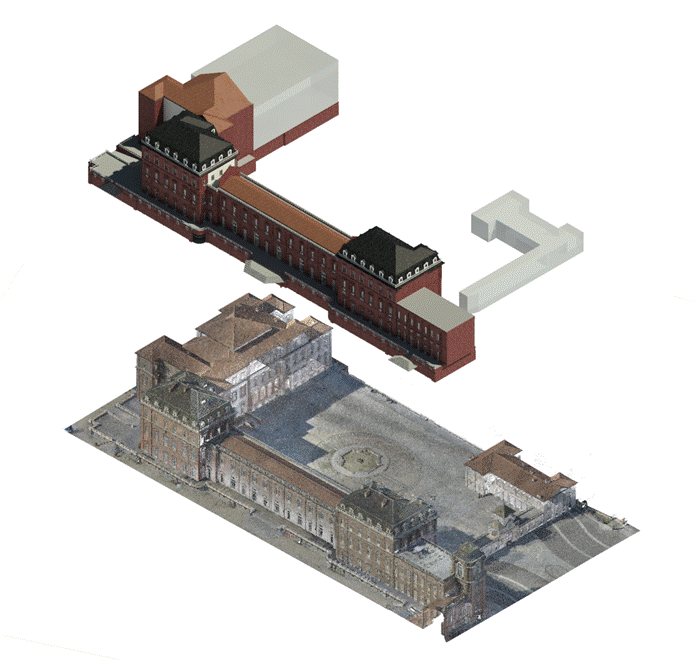
Figure 2 From Pont cloud to HBIM of the Great Gallery of the Reggia di Venaria Reale.
Why HBIM-based Digital/Memory Twinning Matters for HERITALISE
HERITALISE is building a new digital paradigm for cultural heritage by combining multi-sensor data acquisition, advanced processing techniques, AI-led interpretation and interoperable knowledge graphs. HBIM-based Digital Twins fits within this paradigm in several fundamental ways.
1. It enables the integration of diverse heritage data layers
Heritage buildings are not just geometric forms. They are living documents of human activity. HBIM-based Digital/Memory Twins are one of the few frameworks capable of bringing together:
- physical characteristics and material composition
- geometric structure and spatial relationships
- historical phases and transformations over time
- conservation interventions and risk assessments
- intangible CH elements such as stories, uses or local memory (and also the tangible CH invisible to the naked eye )
HBIM-based Digital Twins HERITALISE to enrich digitised assets with layers of meaning that extend far beyond the visual.
2. It improves interoperability across the ECCCH ecosystem
One of the major challenges in CH digitisation is interoperability. Without common frameworks, data cannot be easily reused, combined or migrated across digital platforms. HBIM introduces well-defined structures and relationships that can be mapped onto the semantic frameworks and data models envisioned by the ECCCH. This ensures that data produced through the HERITALISE workflow will remain compatible with future European systems, standards and platforms.
3. It supports long-term conservation and monitoring
A critical responsibility of CH institutions is ensuring that conservation actions are informed, justified and traceable. HBIM models can store detailed records of conservation work, material degradation and environmental conditions. For HERITALISE, this ability to integrate documentation with real-world behaviour is invaluable, as the project aims to take heritage documentation beyond representation and into actionable knowledge that can guide conservation strategies.
4. It enhances education and public engagement
HERITALISE aims to make CH not only more accurate but also more accessible. HBIM-based models can feed into interactive applications, VR/AR experiences, online exhibitions and educational platforms. By linking digital geometry with curated contextual information, HBIM-based Digital/Memory Twins make it possible to create experiences that are both engaging and scientifically rigorous. This is essential to HERITALISE’s mission to broaden public understanding and appreciation of cultural heritage.
5. It supports collaboration and multidisciplinary research
CH preservation requires contributions from architects, archaeologists, engineers, geographers, historians, museum specialists, AI experts and many others. Digital Twin Environments (DTE) provide a shared collaborative environment where multidisciplinary teams can work on the same digital asset with shared understanding and common reference points. HERITALISE, as a project that brings together universities, cultural institutions and technology partners, benefits greatly from this form of structured collaboration.
From Digital Models to Living Knowledge Systems
One of the most transformative aspects of a Digital/Memory Twin is its capacity to go beyond mere HBIM representation. Instead of static models, a Digital/Memory Twin supports dynamic, living systems that evolve as new information is added, new analyses are conducted, or new conservation measures are implemented. This flexibility mirrors the ever-changing nature of heritage itself.
HERITALISE is working to further enhance this capacity by integrating HBIM with AI-enabled tools, semantic networks and knowledge graphs. By doing so, the project aims to move from digital documentation to intelligent heritage ecosystems capable of identifying patterns, suggesting interpretations, or even predicting risks.
In this context, HBIM forms the structural basis on which the Digital/Memory Twin concept functions. A Memory Twin is not just a detailed 3D reconstruction; it is a comprehensive model that includes past, present, and potential futures of heritage assets. HBIM offers the spatial, relational, and semantic framework necessary for Memory Twins to operate.
HBIM-based Digital/Memory Twinning is far more than a digital modelling methodology. It represents a shift toward a more integrated, meaningful and sustainable approach to heritage documentation. By capturing not only the geometry but also the history, context and evolution of heritage buildings, Digital/Memory Twins transform models into living archives of cultural knowledge.
For HERITALISE, HBIM is an essential part within a future where digital CH is accessible, interconnected and enriched with context. It aligns seamlessly with the project’s mission to redefine heritage documentation, making it deeper, more reliable, and more meaningful for communities, researchers and future generations.
In a rapidly evolving digital landscape, HBIM provides the structure and semantic richness necessary to ensure that CH continues to be understood, preserved and experienced in ways that honour its complexity and significance.